From Frequent Borehole Collapse to Efficient Soft Ground Construction: How Did They Achieve It?
With the rapid expansion of underground infrastructure construction in Southeast Asia's coastal cities and delta regions, large-scale soft soil formations have become a common challenge for drilling and foundation engineering projects.
Frequent issues such as borehole collapse, unstable borehole walls, and repeated rework have significantly extended construction schedules and increased project costs. This has raised a common question among industry professionals:
Why do the same drilling equipment and standardized jet grouting methods often deliver very different results when applied in Southeast Asia's soft soil environments?
According to publicly available construction records, many mature soft soil projects across Southeast Asia have already achieved stable and efficient operations. For example, a soft yellow clay formation project in Singapore using double-fluid jet grouting achieved a single-hole construction cycle of only 80 minutes. In Malaysia, another project involving a complex formation consisting of backfilled soil, saturated sludge, and gravel layers achieved an average construction efficiency of 1.5 hours per 22-meter-deep borehole. Within similar geological regions, significant differences in construction performance can be observed.
What adjustments in construction methods, equipment selection, and project management allowed these successful teams to achieve rapid drilling progress with minimal borehole collapse?
This article analyzes the causes behind soft soil drilling failures and explores practical solutions based on publicly available project cases and widely adopted industry practices.
1. Why Does Borehole Collapse Keep Happening?
Borehole collapse is one of the most common geological construction problems in Southeast Asia's soft ground projects. It is not caused by a single factor, but rather by the combined effects of geological conditions, groundwater environments, construction management, and equipment capability.
1.1 Geological Conditions: The Inherent Challenge of Soft Soil
Large areas of Southeast Asia's coastal deltas consist of typical sedimentary soft soils characterized by:
• High natural water content;
• High compressibility;
• Strong thixotropic behavior.
In undisturbed conditions, soft soil particles maintain structural stability through internal water pressure and weak bonding forces. However, drilling operations introduce mechanical vibration, soil disturbance, and continuous water circulation, which can rapidly destroy the original soil structure. When open-hole drilling methods are adopted without effective borehole protection, the surrounding soil can easily soften, deform, and slide into the borehole. As a result, some construction sites experience increased rework rates and reduced drilling continuity.
Typical coastal soft clay formations in Southeast Asia represent a high-risk environment because their borehole stability deteriorates much faster after disturbance compared with conventional stiff clay formations.
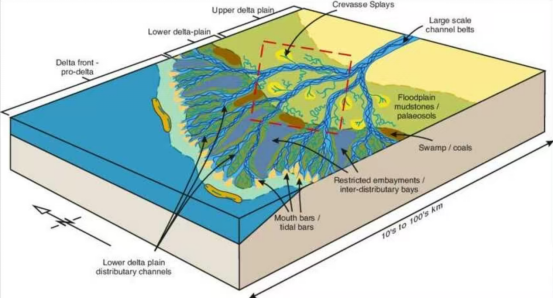
Idealized Soft Soil Deposition Model in Southeast Asian Coastal Deltas
1.2 Groundwater Impact
Coastal cities and river delta regions generally have shallow groundwater tables. Continuous groundwater seepage can gradually weaken temporary borehole protection systems. If drilling fluid properties are not properly controlled or the slurry level is insufficient, the hydraulic pressure balance between the drilling fluid and surrounding groundwater cannot be maintained. As a result, the protective slurry film may be damaged or washed away, directly triggering local borehole collapse or even large-scale wall failure.
1.3 Construction Management Issues
Improper field operations can further increase collapse risks. Typical problems include:
• Excessive drilling depth beyond the allowable stability range of the formation;
• Delayed installation of casing systems;
• Long exposure time of unsupported boreholes;
• Unstable jet grouting pressure control;
• Inconsistent drilling rod lifting and lowering speeds.
During high-pressure jet grouting operations, excessive water jet disturbance caused by improper parameter control can further weaken surrounding soft soil and accelerate borehole instability.
1.4 Equipment Limitations
Equipment limitations are another important factor affecting soft soil drilling performance. Common shortcomings include:
• Insufficient torque stability: Many conventional drilling rigs cannot provide smooth low-speed, high-torque output required for soft soil conditions. Torque fluctuations may increase soil disturbance and reduce borehole stability.
• Lack of real-time monitoring systems: Without digital monitoring modules, operators must rely mainly on experience to judge geological changes. This makes it difficult to optimize drilling parameters in real time.
• Poor adaptability to urban construction environments: Large-sized equipment may struggle to access narrow streets, old urban areas, and restricted construction sites commonly found in Southeast Asian cities.
• Weak overseas service support: Long spare-parts supply cycles and delayed technical support can extend downtime. Interrupted construction increases the probability of borehole instability, especially in groundwater-rich soft soil environments.
2. How Do Successful Projects Solve These Problems?
Based on mature soft soil construction practices across Southeast Asia, the industry has gradually developed a systematic anti-collapse construction approach. The solution typically combines four key aspects:
• Borehole protection technology;
• Digital construction monitoring;
• Equipment and method matching;
• Overseas technical service support.
2.1 Upgrading Borehole Protection Systems
Successful projects usually adopt a dual protection system combining:
• Physical protection through casing;
• Chemical stabilization through modified drilling slurry.
Different protection methods are selected according to specific construction conditions. For geological investigation drilling, lightweight casing advancement is commonly used. For tunnel pipe umbrella drilling and deep foundation pit support projects, longer casing sections are installed to maintain borehole stability. During high-pressure jet grouting operations, high-density and high-viscosity modified slurry is prepared to create a dense protective layer around the borehole. This combination effectively reduces groundwater erosion and mechanical disturbance, significantly lowering collapse risks.
2.2 Digital Construction Monitoring and Parameter Control
Modern soft soil construction increasingly relies on digital monitoring systems to improve drilling stability. Advanced drilling equipment can integrate data acquisition modules to continuously monitor key parameters, including:
• Drilling torque;
• Penetration rate;
• Injection pressure;
• Slurry flow rate;
• Rotation speed;
• Drill rod lifting speed.
Based on real-time data feedback, engineers can dynamically adjust drilling speed, pressure, and operating parameters according to actual geological changes. Complete construction data records also provide reliable documentation for local supervision authorities and project quality inspections in Southeast Asia.
Publicly available industry cases show that jet grouting equipment equipped with drilling parameter monitoring systems can simultaneously record multiple construction indicators, including:
• Grouting pressure;
• Grout volume;
• Drill rod lifting speed;
• Main machine rotation speed;
• Other critical operating parameters.
Continuous data recording enables engineers to review construction performance, optimize geological adaptation strategies, and establish more reliable soft soil construction methods.
2.3 Re-evaluating the Relationship Between Equipment and Construction Methods
Before project execution, contractors need to reassess the compatibility between geological conditions, construction methods, and drilling equipment. Simply transferring equipment and techniques from one region to another without geological adaptation often leads to unstable results.
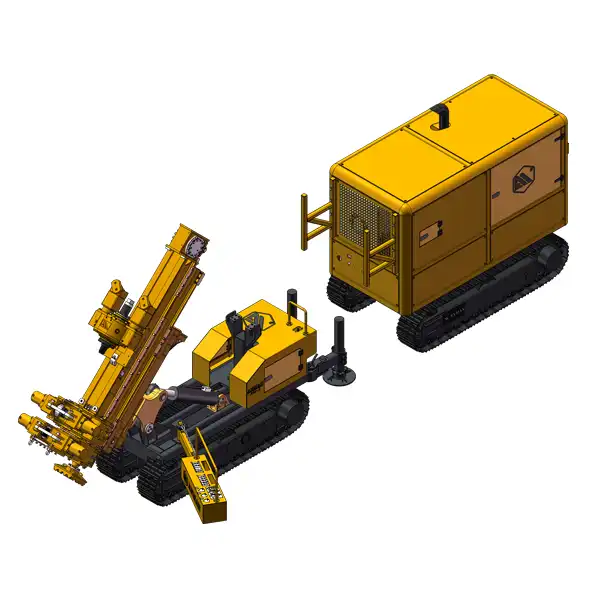
Compact drilling equipment for urban projects: Southeast Asian urban infrastructure projects are frequently located in densely developed areas where working space is limited. Compact drilling rigs with smaller footprints are better suited for narrow streets, underground utility projects, urban renovation sites, and restricted construction areas.
Multi-functional drilling rigs for complex projects: For projects involving multiple construction requirements, multi-functional drilling rigs provide higher flexibility. One machine can perform multiple operations, including pre-drilling, jet grouting, micropile installation, and pipe umbrella drilling. This reduces equipment transportation frequency, improves site organization efficiency, and lowers overall project management costs.
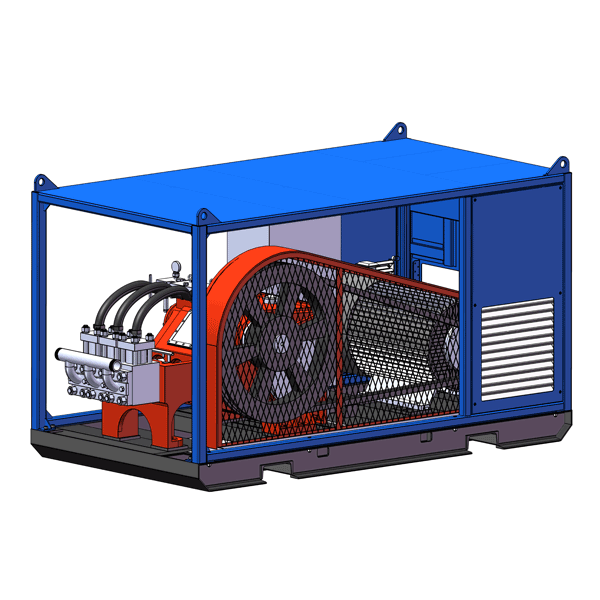
Integrated slurry recycling systems: Supporting equipment such as slurry recycling and treatment systems can improve material utilization efficiency while helping contractors meet environmental requirements in different Southeast Asian countries.
2.4 Establishing Overseas Service Support Systems
For international construction projects, equipment performance alone is not enough. A reliable overseas service system is equally important. Successful contractors usually prepare spare parts inventory in advance, regional logistics channels, and remote technical support systems.
Industry experience shows that overseas projects increasingly rely on remote video diagnosis, online technical communication, construction process demonstrations, and digital operation guidance. When remote support cannot fully solve equipment or process adaptation issues, professional engineers can be dispatched to the project site for direct technical assistance. This combination of remote support and on-site engineering service helps maintain continuous project operation and reduces unexpected downtime.
3. What Are the Actual Results?
3.1 Jet Grouting Project in Soft Yellow Clay Formation, Singapore
The project site consisted mainly of 0–10 m cohesive soft yellow clay and minor fine sand layers. The construction adopted a double-fluid jet grouting method with a designed borehole diameter of 800 mm and borehole depth of 7.72 m. The overall construction cycle was approximately 80 minutes per hole, among which actual drilling operation took approximately 6 minutes. No significant borehole collapse occurred, and no large-scale rework was required. The jet grouting equipment used in this project was the Anman MXL series rotary jet grouting rig.
3.2 Jet Grouting Project in Complex Formation, Malaysia
The geological profile consisted of multiple layers: 0–4 m backfilled sand and gravel layer; 4–21 m saturated sludge layer; 21–22 m dense gravel layer. The project adopted double-fluid jet grouting with a borehole diameter of 1000 mm and maximum drilling depth of 22 m. The average construction time was only 1.5 hours per hole. The standard workforce included 1 drilling rig operator, 1 front-end and back-end coordination worker, and 1 parameter control engineer. The jet grouting equipment used was the Anman SJW series rotary jet grouting rig.
3.3 Top-Drive Drilling Rig Applications in Complex Overseas Ground Conditions
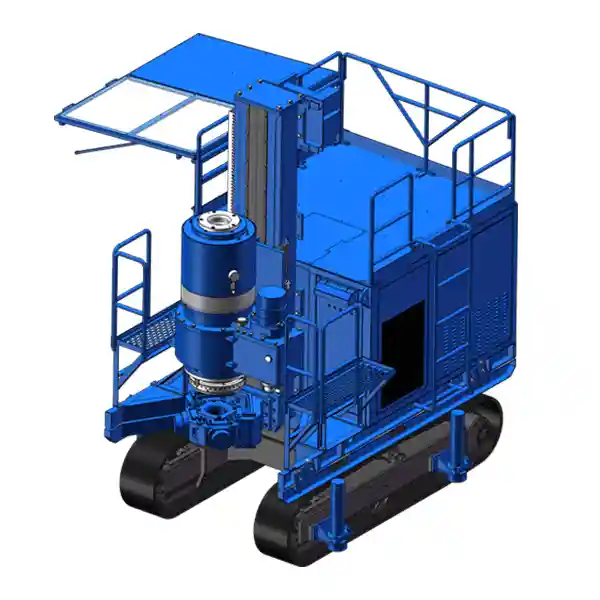
For challenging formations such as sand and gravel layers, soil mixed with crushed stone, and high-water-content soft clay, top-drive drilling rigs provide advantages through low-speed high-torque output, flexible switching between rotary drilling and impact drilling modes, and reduced dependence on down-the-hole hammer systems. These characteristics help reduce surrounding soil disturbance and improve borehole stability. The Anman HDL/AM series top-drive drilling rigs have demonstrated strong adaptability in various overseas geological conditions and have received positive feedback from international customers, including projects in Singapore and Argentina.
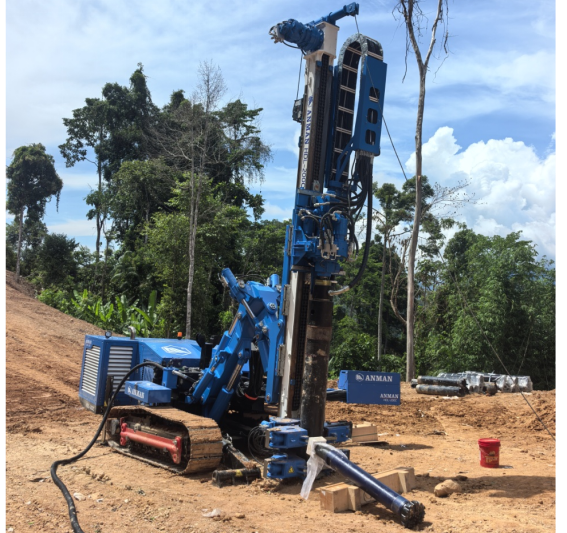
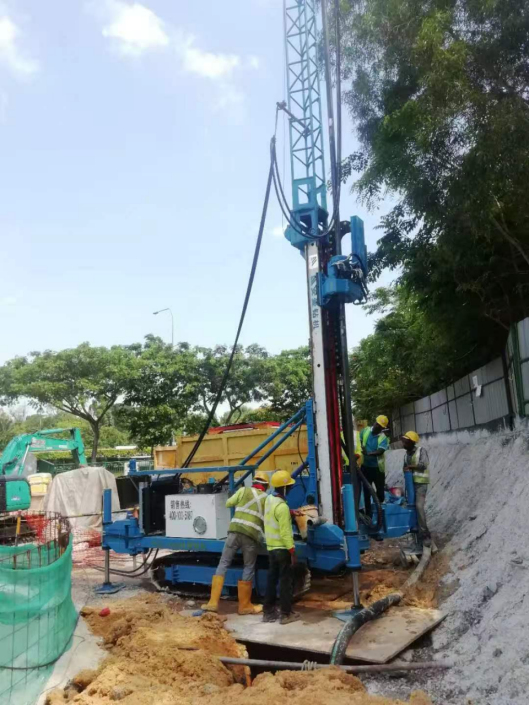
Anman AM-17 construction site in Malaysia
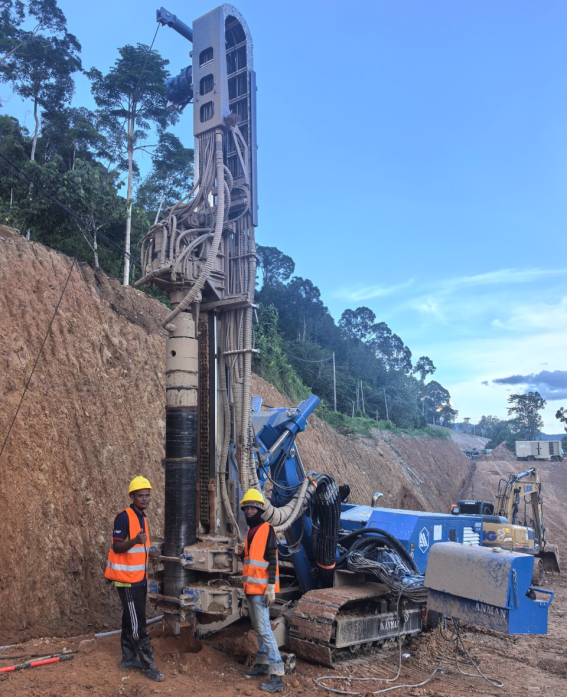
Anman drilling rig at a construction site in Malaysia
3.4 Municipal Pipe Jacking Applications in Singapore
According to a public report from Xishan News, after three to four years of market development in Singapore, Anman drilling equipment has established a stable customer base in the local market. The ground reinforcement drilling equipment used in Singapore municipal pipe jacking projects has adopted Anman drilling rigs in multiple applications, supporting urban underground pipeline renovation projects.
4. Three Practical Recommendations for International Contractors
4.1 Do Not Fight Against the Ground Conditions — Adapt to Them
Soft soil behaves fundamentally differently from hard rock formations. Construction efficiency cannot be achieved simply by relying on higher power output or faster drilling speeds. For soft ground conditions, basic stability measures should include continuous casing advancement, modified slurry protection, and optimized drilling parameters. In extremely weak formations such as saturated clay and sludge layers, properly adjusting injection pressure, drilling speed, and drill rod lifting rate is far more effective for preventing borehole collapse and improving construction efficiency than simply increasing equipment power.
4.2 Equipment Selection Should Prioritize Versatility
Urban infrastructure projects in Southeast Asia often involve limited construction space, changing geological conditions, and multiple foundation engineering requirements. Under these circumstances, a multi-functional drilling rig capable of handling different applications can often provide greater value than several single-purpose machines. During equipment selection, contractors should evaluate the total lifecycle cost rather than only comparing initial purchase prices.
4.3 Supplier Service Capability Is Often More Important Than Equipment Specifications
For overseas construction projects, complex geological conditions and long-distance supply chains create additional risks. When equipment problems occur, the supplier's ability to provide remote troubleshooting, fast spare parts delivery, and technical guidance directly affects project schedule and operational continuity. Even equipment with excellent technical specifications may cause significant delays if the supporting overseas service system is insufficient.
5. Why Does the Same Equipment Perform Differently in Different Soft Soil Conditions?
Although many regions are classified as "soft soil areas", geological characteristics can vary significantly between different Southeast Asian countries and cities. The previously mentioned cases clearly demonstrate this: the Singapore project involved relatively uniform soft yellow clay conditions with consistent soil characteristics, resulting in comparatively lower construction difficulty. In contrast, the Malaysia project involved a complex combination of backfilled soil, saturated sludge, and gravel layers. Frequent transitions between soft and hard layers caused greater disturbance to borehole stability and required continuous adjustment of drilling parameters.
Beyond geological conditions themselves, other factors also influence construction results, including operator experience, process control capability, and equipment-method compatibility. Therefore, there is no universal soft soil construction solution that can be directly copied across all regions.
Conclusion
Looking at the current development of underground construction in Southeast Asia, the transition from frequent borehole collapse to stable and efficient drilling is not achieved through equipment upgrades alone. It requires the combined contribution of geological-adapted construction methods, digital parameter monitoring, proper equipment selection, and comprehensive overseas service systems.
Publicly available construction records from Foundation Engineering Network demonstrate that optimized solutions can achieve approximately 80 minutes per hole in Singapore soft yellow clay and approximately 1.5 hours for 22-meter-deep holes in Malaysia's complex formations. These cases highlight the importance of matching construction methods and equipment capabilities with actual geological conditions.
Southeast Asia's underground infrastructure market continues to offer significant growth opportunities. However, regional soft soil challenges will remain a long-term technical issue for foundation engineering companies. Based on Anman drilling equipment's accumulated overseas project experience, this article analyzed the causes of borehole instability, practical solutions, and construction recommendations, providing reference for international contractors planning or executing soft soil projects in Southeast Asia.
For more customized soft soil drilling solutions, please contact Anman's professional engineering team.