202GW Middle East Solar Market: Desert PV Construction Challenges
From a World Cup Solar Plant to a 202GW Desert Energy Blueprint
During the 2022 FIFA World Cup in Qatar, the Al Kharsaah 800MW Solar PV Power Plant achieved full-capacity grid connection. Located in the desert area west of Doha, covering approximately 1,000 hectares and equipped with more than 2 million bifacial solar modules, the project marked the beginning of large-scale solar development in the Middle East.
(Source: Global Energy Monitor, 2026)
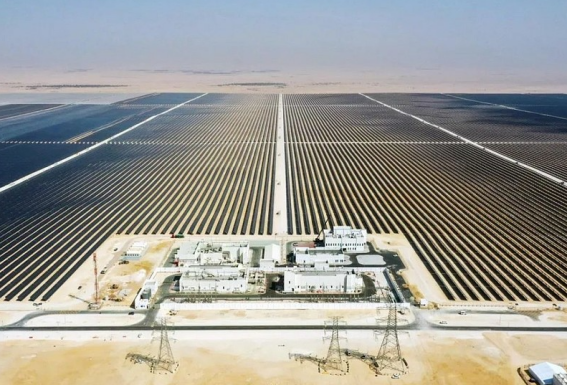
Aerial photo of the Al Kharsaah 800MW PV Power Plant in Qatar
Three years later, solar development across the Middle East has entered a new acceleration phase.
According to the MENA Energy Outlook 2026 published by Dii Desert Energy, the Middle East and North Africa (MENA) region added approximately 15GW of renewable energy capacity in 2025, bringing total installed renewable capacity to 43.7GW, including 34.5GW of cumulative solar PV capacity. The regional project pipeline increased from 131GW in 2024 to 202GW, with solar projects accounting for 130GW — representing a 54% year-on-year increase.
(Source: Dii Desert Energy; TaiyangNews, January 2026)
Qatar has been among the most active markets in the region.
In April 2025, Qatar inaugurated two major solar projects on the same day: the 458MW Ras Laffan Solar PV Plant and the 417MW Mesaieed Solar PV Plant, doubling the country’s renewable power generation capacity to 1,675MW.
In September 2025, QatarEnergy and Samsung C&T signed an agreement to develop the 2GW Dukhan Solar Power Plant. Covering approximately 27 square kilometers, the project will be constructed in two phases.
By 2030, Qatar aims to achieve approximately 4GW of large-scale renewable energy capacity.
As GW-scale solar projects continue to move forward, demand for foundation construction equipment capable of operating in harsh desert environments is also increasing rapidly.
The Larger the Solar Project, the Greater the Challenge of Foundation Construction
The foundation of every GW-scale solar power plant is built on the precise installation of hundreds of thousands of piles.
The Al Kharsaah project covers approximately 10 square kilometers, while the Dukhan project spans 27 square kilometers. Across these vast desert sites, the efficiency and accuracy of pile installation directly influence the overall project schedule and construction performance.
Middle Eastern desert environments create strict requirements for solar construction equipment:
Extreme heat conditions:
During summer, desert surface temperatures can exceed 60°C. Hydraulic systems and engine cooling systems must maintain stable operation under continuous working conditions above 50°C.
Variable geological conditions:
Sand, gravel, and weathered rock formations may appear within the same project area. A single drilling method is often insufficient to handle all ground conditions.
High dust concentration:
Fine desert particles can enter air intake systems and hydraulic sealing components. Without sufficient protection, equipment may experience frequent downtime.
Significant day-night temperature variations:
Temperature differences exceeding 20°C create continuous challenges for structural fatigue resistance and sealing system durability.
These conditions mean that desert drilling equipment requires dedicated engineering solutions for heat dissipation, air filtration, and multi-layer geological adaptability — rather than simple modifications based on standard machines.
Anman Solar Drilling Rigs: Equipment Solutions Verified in Middle East Projects
Anman solar drilling rigs have been deployed in Middle East markets including Saudi Arabia, Qatar, and the UAE.
In 2019, the MXL-150DC participated in a Dubai solar power project, completing practical field validation under high-temperature desert conditions. In 2023, batches of MXL-150DC drilling rigs were delivered to Qatar.
An operator at the Dubai project site gave a direct evaluation of the equipment:“Strong power, large rotary head, powerful motor, and the machine looks excellent.”
For operators working every day in desert environments, field feedback provides the most valuable assessment. The equipment’s power system remained stable during continuous heavy-duty operation, and its reliability was proven under harsh working conditions.
After delivery to customers, the project manager provided four words of feedback:“Well-designed, attention to detail.”
Amman integrates field operating data and customer feedback into continuous product improvement, creating a closed-loop development process:Jobsite → Factory → Jobsite.This approach allows real-world operating data and construction feedback to directly drive product optimization, forming systematic drilling solutions specifically designed for desert working conditions.
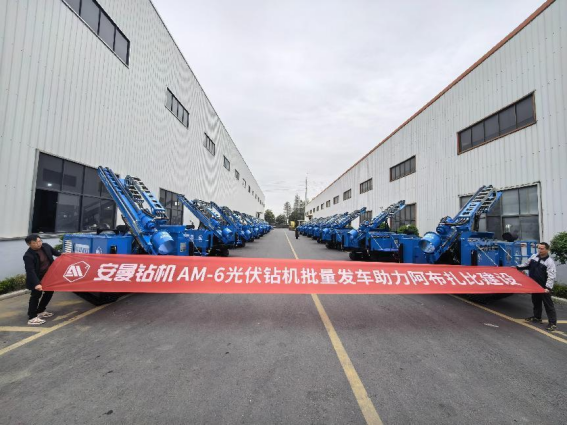
Amman Photovoltaic Drilling Rigs Shipped in Batches to Abu Dhabi
Facing the complex operating environments of Middle Eastern solar projects, Amman currently recommends the following models:
AGL-460: Standard Photovoltaic Drilling Rig for Complex Desert Ground Conditions
One of the most common challenges in Middle Eastern solar projects is geological variability.
Within the same project site, contractors may encounter alternating layers of sand, gravel, and weathered rock. A single drilling method often cannot efficiently cover all ground conditions.
The AGL-460 is designed to address these challenges.
Equipped with a rotary head delivering a maximum torque of 8,500 N·m, the machine can drive auger drilling tools efficiently through sandy formations. When encountering hard rock layers, an optional hydraulic hammer module enables switching to impact drilling mode, with an impact energy of 1,326 N·m and a frequency of 800 bpm, eliminating the need to replace equipment or change the entire construction method.
With 8,500 N·m maximum rotary torque, the AGL-460 offers strong performance among photovoltaic drilling rigs in its class. This allows operators to reduce frequent tooling changes in rocky formations while flexibly switching between auger drilling and impact drilling methods.
Equipped with a newly upgraded adaptive rotation speed control system, Amman has optimized the machine based on field construction feedback. Under typical solar pile foundation conditions, the system can improve construction efficiency by approximately 30%.
This improvement is particularly valuable for continuous operation in high-temperature environments. When equipment efficiency remains stable under extreme heat, contractors can maintain consistent daily pile installation output.
(Actual efficiency may vary depending on geological conditions and operating environment.)
The AGL-460 features:
4,600 mm mast travel, enabling efficient drilling operations;
6,000 mm maximum pile pressing stroke, suitable for installing steel piles up to 6 meters long;
Compatibility with foundation designs commonly used in large-scale Middle Eastern solar projects.
The mast provides:
110° vertical adjustment range
90° boom swing angle
15° left swing and 25° right swing capability
These functions allow operators to quickly align drilling positions on uneven desert terrain — a critical advantage in environments where temperature changes and ground settlement may affect site conditions.
Designed for high-temperature and high-dust environments, the AGL-460 is equipped with:
Reinforced air filtration system;
Large-capacity hydraulic oil cooling system;
96kW diesel engine;
110-liter fuel tank for extended continuous operation.
With an operating weight of approximately 7,000 kg and travel speeds of 2,500/4,000 m/h, the machine provides the mobility required for large-scale solar foundation construction and frequent site relocation.
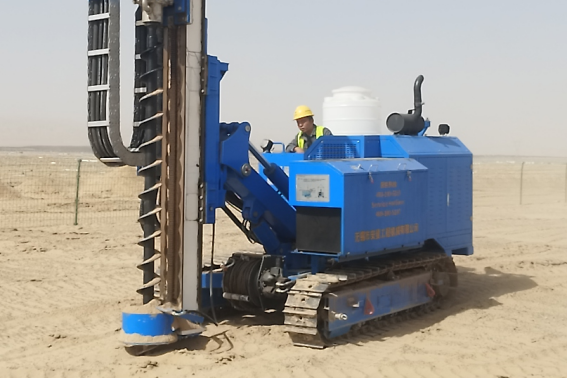
Anman AGL-460 at a construction site in the Middle East
AGL-460G: Specialized Model for Rolling Dunes and Rocky Desert Terrain
Some Middle Eastern photovoltaic projects are located in areas with rolling sand dunes, rocky plateaus, and uneven desert terrain. These environments often involve significant elevation changes and steep slopes, which can limit the mobility and stability of standard drilling equipment.
The AGL-460G is designed to enhance terrain adaptability based on the standard AGL-460 platform.
Its key improvement focuses on mobility and stability under complex ground conditions.
Equipped with telescopic high-low crawler legs, the AGL-460G increases its maximum slope adaptability from 25° on the standard model to 30°, allowing stable operation on loose sand, uneven terrain, and inclined surfaces.
This design directly addresses one of the biggest challenges in hilly desert construction — maintaining stable equipment positioning during drilling operations.
The AGL-460G retains the same high-performance drilling capabilities as the standard model:
8,500 N·m maximum rotary torque
Optional hydraulic hammer function
1,326 N·m impact energy
800 bpm impact frequency
The system enables efficient drilling in both sandy formations and rocky desert areas.
Its adjustable working structure includes:
110° mast pitch angle
15° left and 25° right mast swing
90° boom swing angle
These functions allow operators to accurately position drilling points on inclined rock surfaces and uneven terrain.
For remote desert construction sites, fuel supply efficiency is another important consideration.
The AGL-460G increases fuel tank capacity to 160 liters compared with the standard model’s 110-liter tank, reducing the frequency of refueling operations.
For solar projects where construction points may be located dozens of kilometers away from service bases, fewer refueling stops mean more effective working hours and higher overall productivity.
The design philosophy behind the two models directly corresponds to real construction challenges in Middle Eastern photovoltaic projects:
8,500 N·m torque reduces the need for frequent drilling method changes in rocky formations;
The adaptive rotation speed system helps maintain efficiency during high-temperature continuous operation;
Telescopic crawler legs improve stability on uneven desert terrain;
Optional impact drilling capability allows one machine to cover a wider range of geological conditions, from soft sand to hard rock.
The combination of AGL-460 and AGL-460G provides comprehensive coverage for two typical Middle Eastern solar construction environments:
Flat desert areas dominated by sand and gravel formations
Rolling dunes and rocky plateau areas with complex terrain
Market Opportunities for Solar Foundation Construction Equipment in the Middle East
With a 202GW renewable energy project pipeline, the Middle East is expected to continue generating large-scale demand for solar foundation construction equipment in the coming years.
Qatar’s 4GW renewable energy target, together with the UAE’s plan to increase renewable energy capacity to more than 22GW, is driving the region into a long-term phase of high-density solar construction activity.
(Source: Dii Desert Energy; Gulf Times, 2026)
As large-scale photovoltaic projects continue expanding across the region, foundation construction equipment is facing increasingly demanding requirements for efficiency, reliability, and environmental adaptability.
Based on real project experience, Amman will continue optimizing photovoltaic foundation drilling equipment designed for extreme environments, including:
High temperatures;
Heavy dust conditions;
Complex geological formations.
The company aims to provide more reliable foundation construction solutions for global solar energy development.
About Anman Engineering
Anman specializes in the research, development, and manufacturing of solar drilling rigs, anchoring drilling rigs, jet grouting rigs, and other foundation construction equipment.
With products exported to more than 20 countries and regions worldwide, Anman provides professional equipment solutions and overseas project support for global foundation engineering applications.
Learn more about product information and overseas project cases through: Engineering Cases
Looking for foundation construction equipment for Middle East solar projects?
Contact Anman’s overseas business team for professional equipment selection recommendations.